Weasality - A Survey
In the ancient times before costco guys walked the earth, the twitter user roon was the first to ever successfully cleave the world perfectly in two:
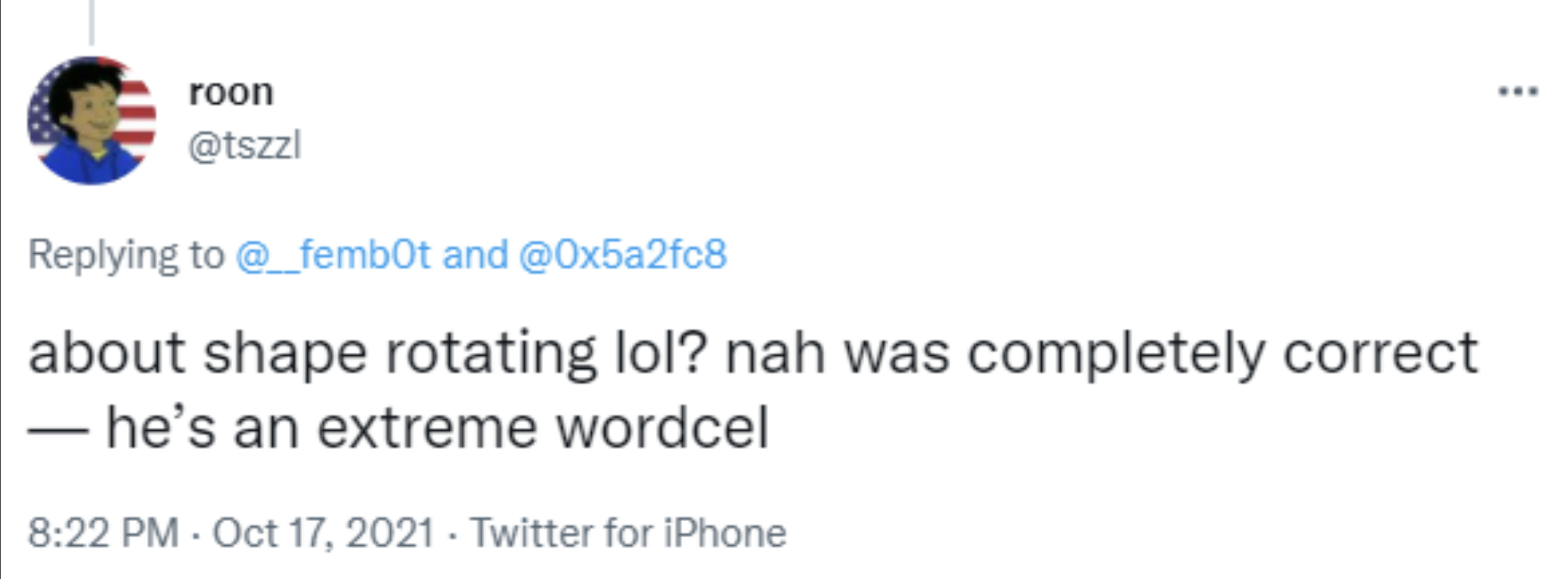
You are either a wordcel or a shape rotator, said he. Either you seek to appeal to language, or to material reality. Either you are convinced by a cleverly phrased argument, or by raw unchewed data.
You may already be picking up on a tiny narrative creeping in. This tweeter and his rogues gallery of gadflies (Marc Andreessen? Sam Altman?) that embraced the brave new dichotomy clearly think it is superior to be a shape rotator.
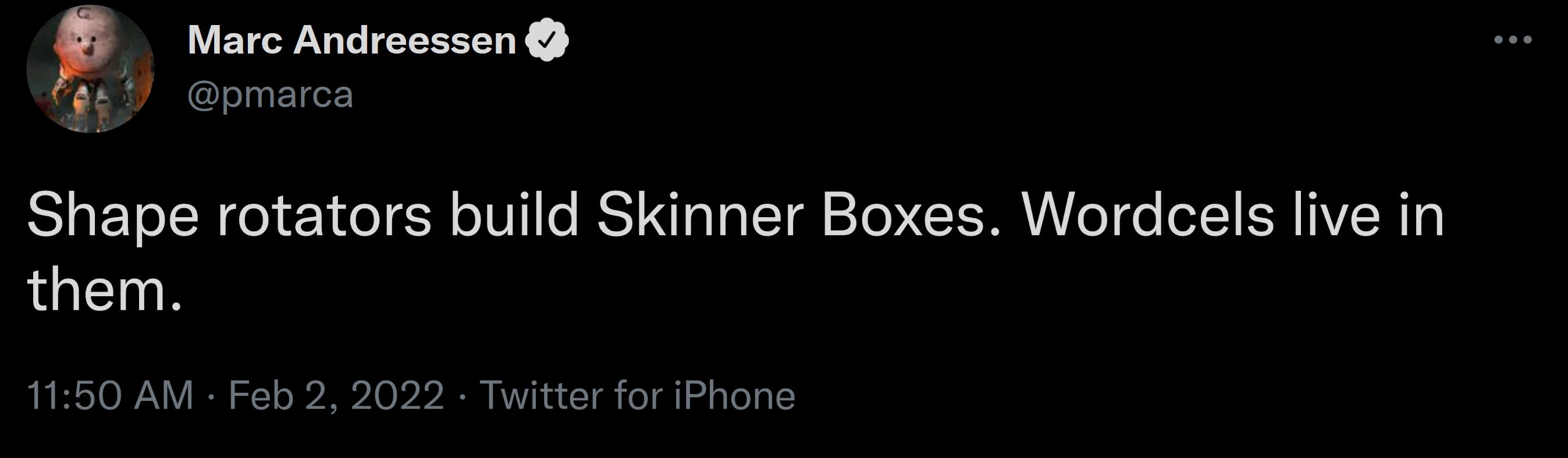
wait is it cool to build skinner boxes?
They waded into the discourse to construct this self-congratulatory framework with, heh, words instead of just letting the magnificent rotations of their shapes speak for themselves. Feels a little ironic, even hypocritical? The guy who coins new words like this, and the other guy who giddily seizes new coinages and flings them at his opponents—you would think they would fancy themselves word guys, right? You would be surprised to learn that they regard the word guys as untermenschen, right? Maybe roon didn’t cleave the world in two after all, let’s get back to work on that.
But I am not afraid to own up to it! I am a wordcel! I think roon is a wordcel too, just in denial. He tweets too much not to be. I looove stealing frameworks and vocabulary to better comprehend the world even when I don’t necessarily agree with the motives/theses of the originators. I also love redefining said vocabulary for my own nefarious purposes and using it in twisted and out-of-distribution ways that are unrecognizable to their originators! Muahahaha!
Computer programmers? Wordcels. Artists? Shape rotators. To me shape rotation implies physicality, tangibility, not merely the negative image of language. If anything wordcel should be the negative image of shape rotation, encompassing those abstract human pursuits like math and economics that don’t involve rotating any actual bloody shapes! But as always the common usage has quickly decayed to the lowest common denominator. Now it’s shape rotator = cool based STEM and wordcel = sissy humanities, which makes it not any more useful a descriptor than the words we already had for those.
Let’s give it another go, why don’t we? Let’s get it right this time.
Fine I’ll Make My Own Word
First off, any attempt to neatly separate people or things into categories is doomed to fail. I prefer the Big 5 approach of scores on a spectrum over the MBTI approach of binary categories. We need only coin one word for our score, and it needs to capture a scalar rather than a state. The thing we’re after isn’t tangibility vs abstraction, it’s how much one can deploy words and social engineering to claim victory/truth vs how much the truth/goal is self-evident and impossible to fake. And finally, this is a quality of human endeavors, not humans themselves. Using this term to critique a field does not entail critique of the individuals within the field, who are faultlessly following incentives.
I want to convince you this is a useful concept to think about, but first I need to be absolutely sure we agree what it actually means, so let’s do a survey of human endeavors and score their weasality.
Grading the Weasality of All Human Pursuits
Math: Low but Nonzero
Math is a natural place to start as it is one where me and roon disagree about the shape rotatingness. Math—beyond arithmetic and geometry—is an entirely abstract way of relating to the world. One might argue that math has a lot of useful things to say about the physical world, especially calculus and linear algebra. But how do we engage with the math itself? You don’t do calculus on an abacus or with baskets of vegetables. You do it with little glyphs that Newton and Leibniz can’t even agree on. Read a little bit of the history of that era and you’ll realize that the ways we approach something like calculus are totally made up, and we could just as easily have a whole different set of notations and terms and operations. And this isn’t even to speak of the really high level stuff like topology and analysis and group theory and logic.
Nevertheless, while math is highly abstract it scores very low in weasality. It has rules, those rules are fairly straightforward to encode as software, and thus everything you can do will either be formally proven to be true or not. But it does not score a perfect 0 in weasality. Not all proofs are created equal in regards to their utility and applicability to what we conventionally call math. It can be difficult to catch errors in proofs of sufficient complexity, but the error often does not invalidate the conclusion!
Physics: Low but Nonzero
Physics is applied math with an added dash of empiricism. It’s not easy to fake a result here because any novel finding has massive implications and will have a lot of people eager to replicate it.
On the other hand, most of the remaining open questions (e.g how to reconcile general relativity with quantum mechanics, definitively observing all the elementary particles and fields, dark matter) are incredibly hard to prove empirically. Gravitational waves were first observed in 2015 after being theorized for almost a century. We only really took a picture of a real black hole—despite general relativity proving without a doubt they exist—in 2019.

The complexity required to produce observations at the frontier—think of how many billions were spent on the LHC to first observe the Higgs Boson in 2012—along with the fact that some of the greatest discoveries in physics were entirely theoretical and proven empirically later (e.g. general relativity) has opened the door for some weasel behavior. Not everyone has the time and money to construct a laser one hundred thousand times more powerful than the most powerful laser ever created just to empirically demonstrate the Schwinger Effect. Where’s the glory in that anyway? Schwinger already did the math, let some other dope do the empirical grunt work. The real fun is theory, Einstein style. Thus we get entire schools of theoretical physics with dubious explanatory power and very high weasality, like String theory. They commit the cardinal sin of rationality: taking observations and reasoning backwards to causes rather than making novel predictions and then successfully observing them. Still, setting aside theoretical physics, overall very low weasality.
Medicine: Concerningly High
“Do no harm” is an oath that many physicians swear to1. Then they go on to suck up an entire fifth of the GDP for dubious benefits:
There was in fact a period of great length, extending far beyond Pythagoras and Principia Mathematica up to the very very recent past, where seeing a physician would just as likely harm your health because they would bleed you to balance your humors or give you an orbital lobotomy to make you more agreeable (truth nuke: there’s no way we can be totally confident that every mainstream treatment we do today is perfectly safe and efficacious and won’t be grouped with lobotomies as a ridiculous folly some time in the future). The fact that these harmful practices lasted as long as they did while humanity was simultaneously correctly modeling trigonometry and motion and infinitesimals indicates that medicine has a bit of an unsolved feedback problem. I see two major causes:
First: there is a high level of variation between patients, even if they appear the same outwardly. If this were the case in math it would be like if every time you wrote down an integer it contained a secret mantissa with some random value, such that 2 + 2 usually equals 4 but sometimes it equals 5 and sometimes it equals ~6. And the errors compound across all operations. So you can come up with a useful treatment and establish a causal process for it in the body, but that doesn’t necessarily generalize to all bodies, and it interacts destructively with other treatments.
Second: biology is incredibly, unimaginably complex. The vastness of a cutting edge computer pales in comparison to even a simple organism, because the computer is created following logical principles designed by humans, whereas an organism arises from random gradient descent. Okay—there is some unified guiding principle behind the drunken stumble of natural selection. We call it “fitness”. Alas, fitness applies to individual traits and the genes that code for them just as much as it does to the organism itself. This turns what appears to be a single unitary body into such a chaotic system of competing phenomena that trying to predict anything by reasoning about fitness will get you about as far as trying to predict the motion of a feather in a tornado by adding up the forces. Instead you just gotta shut up and dissect ten thousand cadavers and run a hundred thousand RCTs and then maybe you’ll understand one tenth of a percent of what’s going on in there.
Physicians searching for a diagnosis and corresponding treatment for your certain situation run on heuristics like the rest of us. All of the medical information your physician went into crippling debt to learn is available online for free. What you’re paying through the nose for is the comfort of knowing this medical professional has been exposed to that information in a structured environment, and then layered years of in situ experience on top of it. It’s a theatrical performance for your peace of mind. One could imagine a future where we finally figure out some cheap Theranosesque superdiagnostic machine, stick it in every corner pharmacy, run the results and questionnaire through a classifier trained on every human’s biomarkers, and then write you a prescription right there, or maybe refer you to another on-demand scanner or robot surgeon. This cold steel system of automated healthcare wouldn’t win any awards for bedside manner, but they also wouldn’t forget to wash their hands or accumulate huge backlogs and the rate of iatrogenic death and injury would plummet.
Everything from the placebo effect to homeopathy to the fact that mortality rates drop when cardiologists are out of town for conferences points to medicine as a human endeavor impossibly twisted up with psychology, spirituality, and sociology, something far far more complex than “deploy treatment, heal patient”. And every individual involved, from the award-winningest surgeon to the humblest orderly, is ultimately showing up to a job that they hope to continue making the same or even more money from, even while human flourishing is at stake. Which leads to the strange situation we’ve found ourselves in, where billions upon billions of dollars are expended to keep people alive in a constant state of suffering long past their natural expiration date:
And the cancer of the medical system only grows, sucking up more and more of the output of the economy to keep more and more bedsore-ridden octogenarians alive for just a couple more years. At some point we must ask ourselves if we’re actually making the world a better place by treating life as an end in itself, even when that means sacrificing the productive outputs of the bone-weary working class to the god of torturous lifespan. Just an idea, maybe we could reallocate some of those resources to improving the lives of the ambulatory.
Medicine is a domain of concerningly high weasality. The weasel part is convincing patients and their families that they got their money’s worth (cost-insensitive insurance money, that is) via medical performances. And marketing to prospective patients that said performances are instrumental to their wellbeing. Our progress in eliminating diseases via vaccination and sanitation and drug discovery is inspiring to me and I am very grateful for it. But in the process we built an unstoppable institution of immense political and social power that is now the largest private employment sector in America and it has shown no signs of slowing down. Healing me is no longer the north star, it has subtly shifted to convincing me that I needed healing.2
Entrepreneurship: It Depends
As an entrepreneur, there are two populations to squeeze money out of:
- Customers who will give it to you in exchange for goods and services. We like to refer to this basket of preferences metonymically as “the market”. The market giveth and the market taketh.
- Speculators who will give it to you in exchange for equity in your company in the hope that stake will be worth more in the future. Confusingly, we also like to refer this group of moneyed individuals and institutions metonymically as “the market” (or if you wanna get political, “the forces of capital”). They come in many different flavors: venture capital, angel investors, business loans from banks, private equity, retail investors, hedge funds, etc.
The product market is incredibly low weasality. You can maybe get somebody to buy something they don’t need or want with a herculean marketing push or some fraudulent misrepresentation, but beyond that you are a slave to consumer demands.3 The capital market on the other hand is absurdly high weasality. Tech venture capital especially will throw enormous amounts of money at dud startups (and as a group the VCs set their own valuations and deal mostly with each other until they dump the equity on the public market after convincing everyone else it is truly worth that much) because they carry such a broad basket of bets that some will pay out bigtime and cover all their losses elsewhere. It’s really not that hard to acquire a couple million in seed funding if you know the right person, you manage to go viral, or you have a knack for pitching. VCs aren’t nearly as enlightened as they like to think they are and get sucked into trends and herding just like the rest of us.
Startup founders are a weird mixture of weasels whose main talent is blustering on linkedin on the one hand and some of the smartest and highest agency people you will ever meet on the other. You have to be adaptable and intense if you want to win over the product market. You have to be good at persuasion and PR if you want to win over the capital market. Some winning teams seem to have one founder that does the weasel work to get capital to unblock the other guy, the psychopath with monomania.
Sometimes the monomaniacs can bootstrap their profitable business with minimal or zero seed money, like what my wife has done with her photography business. In my humble opinion this is entrepreneurship at its purest and most laudable, unadulterated market strategy and grind without the circus performance to convince Sand Hill to give you some money. It’s just a little bit grating to see some masterful weasels fail upwards through multiple funding rounds without actually creating any meaningful value just because they’re talented at narrative building.
Lightning round
These are getting too long, let’s pick up the pace!
The Trading of Financial Securities and Other Miscellaneous Gambling: Very low
Either you make money or you lose money!
Warfare: Low, but…
You either lose or win the war. Except not really, most modern wars end in stalemate or white peace or mediated compromise, not unconditional surrender. At which point you may begin the spin. How many Americans understand that we lost the Vietnam War or the War in Afghanistan? Still, the tactical act of prosecuting a war is profoundly low weasality. No amount of narrative will stop an enemy at the gates (though it might boost your morale!).
Software: Completely Up to You
Users and systems tolerate a surprising amount of suck. Because you ideally want to evaluate software on its own merits rather than lossy market signals, you need to create KPIs and metrics to understand how you’re doing vis-à-vis feature velocity, user satisfaction, reliability, resource usage, sources of regular regression, logical bugs, etc. Each of these can be tracked and prioritized, and each can be weaseled if you fail to pay your dues to Goodhart.
Hardware: Lower than Software
It’s once again a game of instrumenting KPIs, but there are definitely fewer “bugs”—defects are more likely to be too obvious and catastrophic to slip through.
Food: Surprisingly Low
While there is some wiggle room in “service” and “presentation”, I think it is very hard to convince someone that their senses are deceiving them in a socially deprived environment like home cooking or fast casual. That means delicious food is an objective thing, inasmuch as a consensus of subjective assessments can be called objective.
Your Career: EXTREMELY HIGH
You can be a legend at what you do and if you fail to convince the powers that be that you are a legend then you will get very little recognition. Conversely you can be a waste of space yet convince them that you deserve to run the company. It’s pure narrative.
Academia: Regrettably High
Science is cool because it has corrective feedback mechanisms that prevent it from going permanently astray. We’ve had a lot of misadventures along the way that left many victims in their wake, but we’ve always emerged smarter with strengthened rigor and self-criticality of the field in the end (with some assists from exterior institutions like government regulation). Still, the journey is far from over. There are countless unrigorous and completely politically captured “scientific” journals in the humanities, yet the replication crisis hit the empirical fields (because, of course, one cannot replicate a non-empirical paper! it’s just vibes!). An enormous portion of formal research is conducted in universities, which with few exceptions are insular clubs of tenured faculty inescapably tethered to donor interests presiding over an underclass of adjuncts and graduate students. There are a lot of weaselable hazards here, misaligned incentives to inflate one’s citation metrics or further tenure prospects. It’s not all bad, there are countless beautiful souls serving the transcendent goals of growing humanity’s knowledge and teaching the next generation, but that’s just not where the incentives tend to point.
Foreign Languages, Sports & Athletics, Musical Instruments: Nearly Nonexistent
The reason that personal skills like polyglotism or playing an instrument are such attractive traits to suitors or employers is that they’re the closest thing to impossible-to-fake competency signals. Just don’t fall for the dudes that memorize two Zelda songs via YouTube tutorials, they cannot in fact play the piano.
Art AKA Music, Writing, Film, Video Games, Visual Arts: I’m Not Sure
Left as an exercise to the reader.
Why Weasel Wins W.R.T. Wordcel
Wait, all we’ve accomplished here is coming up with a new mean word that starts with W to lob at those silly billies in the humanities. What was the point of this whole exercise?
In the modern western world of excess and plenty, the new most valuable source of wealth (aside from your health) is meaning. People who do very well by material standards often suffer a crisis of meaning at some point, stereotypically in one’s middle age, though I’m increasingly seeing younger people crash out over feelings of emptiness and lack of direction. Some say the balm is lifelong learning, connecting the dots. I disagree. Knowledge and education have never been more accessible than the present, yet our meaning crisis seems to only mount. No number of blog post explainers or video essays will fill that hole for you.
What weasality tracks is one’s exposure to such crises of meaning. We’re going through a massive one in the age of AI, where the once reliably high-status white collar jobs seem balanced on the precipice of irrelevance. I’ve heard that knowledge workers are rejecting “workism” and returning to “real” projects like knitting. Methinks it’s not really work that is the issue. Construction workers aren’t having the generational meltdown about AI that I’m seeing from software engineers. What we really want is to have done work that can’t be counterfeit. That is what the LLM is: a master counterfeiter, producing counterfeits so slick and so cheap they’re increasingly preferable to the expensive and imperfect originals. Maybe the counterfeits are “inhuman” or “uncanny”, but our economy has time and again expressed a preference for affordability and convenience over quality or humanity.
LLMs are the ultimate, final boss of weasels. The sole thing they know how to do is weasel: RLHF is the process of convincing humans you’re a smarty pants. That’s not to say the model is useless—how many of the high weasality domains we identified above are something you’d like to live without? And they’re increasingly attacking our abstract low-weasality strongholds like mathematics. Maybe the real differentiator in the AI-dominated future for desirous to dodge obsoletion will be cyberspace vs meatspace. But maybe not. I don’t believe in extrapolating graphs, so the book is not yet written on where this is all headed.
In which case—if the option is yours and you’re not already hopelessly pledged to your chosen career—weasality is an important factor to consider when choosing a path through adulthood. It’s a valuable lens to use to reflect upon your own journey of accumulating knowledge and skills. The way of the weasel tends to be easier for a gifted communicator. Until it’s not.
1.
Yes I am aware that primum non nocere is actually from Epidemics I and the Oath in fact says: “Into whatsoever houses I enter, I will enter to help the sick, and I will abstain from all intentional wrong-doing and harm”, your pedantry is quite unnecessary. ↩
2.
Medicine as a reaction to disease may be hopelessly in the clutches of Goodhart and Moloch, but there are still a host of well attested prophylactic interventions that you are likely not attending to optimally. Really boring obvious stuff that could save you tens of thousands of dollars and years of morbidity in the future: regular strenuous exercise, avoiding highly processed foods, sufficient sleep (more than you may think you need!), improving air quality, maintaining a healthy weight, breaking up long sedentary periods, eliminating smoking and alcohol. If we could spend money to move the needle on these (like paying people to exercise or get on a diet?) then we could probably eliminate a bunch of inefficiency from the economy. It would be hard to monetize and it would shrink the gross revenue of the healthcare industry so you won’t ever see prophylactics get truly institutionalized by a market economy, but maybe we could make the Physical Jerks a real thing! ↩
3.
Given we’re talking about a consumer market. In the enterprise world you can weasel your way to incumbent status on the back of an atrocious product with a talented enough sales team. B2B SaaS also makes up the majority of fundees in the famous startup incubators. Coincidence? ↩