Trimodal Political Ethics - A Modest Proposal
I always strive to be a charitable conversator/reader/viewer. One need only encounter a single bad faith interlocutor to quickly become an expert in why good faith is important. Disingenuity, nitpicking, and all the other (sometimes accidental) social defections are incredibly easy to deploy against a claim-maker to waste their time and fail to engage with their arguments.
But there are almost always some serious tradeoffs to any strategy—conversational or otherwise—and good faith is no exception. I find that charity acts as sort of a fail open rather than fail closed error mode. My weakness sits not in rejecting valid arguments but in too readily accepting dishonest or fallacious ones. I have become easier to influence and convince. In fewer words: I’m gullible.
I can somewhat defray the negative effects of this stance by adopting a complementary “fool me twice” strategy where I lean very hard on the ethos of the claim maker. Your average debatelord probably believes that logos is the sole valid form of rhetoric, but that only holds true in conversation between two logical beings. I have come to understand during this sojourn on earth that both you and I are deeply illogical beings, and I can be led down any old winding road of belief with a bit of guile and/or deluded sincerity. Even my strategic assessment of your credibility is ultimately subjective!
But you must have some sort of foundation you can fall back upon when digesting rhetoric. You can’t just be a blank slate that anyone could come along and shape into their own image. There needs to be something more foundational to your identity, beyond convincing. The common response that I see folks have to this dilemma online is just giving up on trying so hard to be good faith and going to wrestle in the mud with the other kids, perfectly convinced of their own perspectives and ready to evangelize them. But there’s another option: color your positive (factual) claims with normative (prescriptive) values. In other words, build your politics upon an ethics.
I: But Which One
Normative ethics are a vast and complicated academic field that I’m not any sort of expert in. Nevertheless, we can mostly distill it down to 3 main schools that dominate the conversation and have academic philosophers almost evenly split between them. Let us refresh our understanding of them. (Skip to section II if you took Ethics 101 and feel confident in your knowledge of the big three)
1. Consequentialism
One ought to justify actions backwards from consequences.
The manner in which the consequences are arrived at—the means—are not relevant if a precise accounting of the consequences comes out favorable. Machiavelli famously said “the ends justify the means”. Well no, he didn’t say that, he actually said:
I’ve always thought this sounds more like a public relations tip than a broad ethical claim. It also seems to take a rules-based order (“no court to appeal to”) for granted, and only applies this consequentialist framing to an ultimate authority with no higher ruler (i.e. the sovereign of a polity). But “the ends justify the means” is still a very good distillation of consequentialism’s core claim.
Consequentialism’s opponents will often lodge weaksauce attacks about this or that terrible outcome emanating from the methods employed, but if said terrible outcomes are not being accounted for then it’s not real consequentialism. Consequentialism is only interested in consequences, you literally can’t criticize it (well, actually you can, but I’ll show you how later) from the outcomes direction, because that would be engaging in… consequentialism!
The most popular flavor of consequentialism is utilitarianism. That is the employment of a method that tells us which outcomes are desirable that we call the utility function.
2. Deontology
Ethical living comes from identifying and following the correct set of rules.
Immanuel Kant had a dream: what if you could derive morality purely from logic? What if morality was nothing more than the inherent preoccupations of a perfectly rational will? He was very interested in building an ethical system that could unassailably overcome the confused and deficient moral systems bouncing around at the time. Utilitarianism only managed to kick the can down the road to the utility function, itself still a subjective construct. Kant proposed what he called pure practical reason, the sole set of rules and demands that were not self-defeating or contradictory. They all ultimately emanate from a foundational categorical imperative, which he formulated in multiple different fashions, including:
THE FORMULATION OF UNIVERSAL LAW
THE FORMULATION OF HUMANITY
and so on. Compare and contrast this to the “ends justify the means” of consequentialism and you shall immediately see where the tension lies.
Kantian ethics is not the only school of deontology (btw the term is not de-ontology as in anti-ontology but deon-tology as in the Greek word deon meaning duty). A lot of religious systems are also deontological because they are more concerned with rules aka means than outcomes aka ends1. But Kantianism’s pure simplicity and the upgrades it received in the succeeding centuries have prevailed as the most recognizable flavor. In essence, Kantian ethics is to deontology what utilitarianism is to consequentialism.
3. Virtue Ethics
Morality is the behavior of a virtuous person. Become a virtuous person, and you shall act morally.
While deontology and consequentialism are primarily concerned with the act—whether it abides by maxims and duties, whether it produces desirable outcomes—virtue ethics is primarily concerned with the actor. Virtue ethics prescribes the set of actions that produce virtue within you, actions that would have been chosen by a virtuous person. What those virtues are and how they rank against each other are once again a subjective source of debate, just like the utility functions of consequentialism or duties of deontology (unless you’re Kant in which case you’ve derived it from base principles or whatever).
Aristotle identifies the telos (end) of human existence as eudaimonia (flourishing), only attainable via arete (virtue). But what is virtue? Acquire enough phronesis (wisdom) and you shall know instinctively, but he goes on to list a bunch of explicit virtues. Each exists as the golden middle of some continuum between a deficiency and an excess, e.g.
- Cowardice - Courage - Recklessness
- Deprivation - Temperance - Indulgence
- Parsimony - Liberality - Prodigality
and so on.
Virtue ethics may be the most subjective of the three, but it’s also the most intuitive. It is usually straightforward to ask yourself the question: “Is this act courageous? Or is it cowardly? Or is it reckless?” Even easier, find an exemplar of a virtue, gain an intuition for their character, and then regularly ponder how they would act in your situation: “What would Jesus do?” Seneca said as much:
Soooo which one should we build our politics on? Now that we understand the theory of each, let’s examine how they play out in practice and consider which one is most advantageous.
II: Lawz R00l Despots dr00l
If you’re reading this, odds are you live in a nation governed by laws. Odds also are that you or somebody you know belongs to an organized religion governed by commandments. Deontology is the incumbent when it comes to organizing human society, and it’s not hard to see why. However cool the other two value systems may be, they are hard to enforce consistently. How do you punish someone for behaving with insufficient temperance? Do you punish the murderer but let mere attempted murderers walk free?
That’s not to say the reasoning underlying the laws is deontological; it’s actually mostly consequentialist. We don’t imprison attempted murderers for violating some transcendent duty to not attempt murder, but because attempted murderers are more likely to become successful murderers and murder is deleterious to society for various reasons I hope I can skip explaining.
But not all consequences are created equal. Laws are created by the people for the people, and the people vary. Some of the people are rural farmers, and they’d prefer a set of laws that maximally benefits them. Others are city-dwelling white collar workers, and they might prefer quite a different mix of laws. Some people are religious and some aren’t. Some people are men and some people are women. So on and so forth.
We can coarsely deal with this issue via municipalities and federalism and other such schemes to devolve legislative authority down to smaller chunks of the nation. But that only works for issues of geography. You shouldn’t customize laws to favor or disfavor groups of people, that’s discrimination. In The Morality of Law Lon Fuller lays down 8 desiderata to have something one might call “the rule of law” rather than the whims of an individual (i.e. despotism):
- Generality — laws must apply to classes of subjects, not target specific individuals
- Promulgation — laws must be publicly announced
- Prospectivity — laws must apply to future conduct, not retroactively punish past actions
- Clarity — laws must be intelligible and understandable
- Non-contradiction — laws mustn’t conflict with each other
- Stability — laws mustn’t change so frequently that subjects aren’t able to orient their behavior around them
- Possibility — laws mustn’t require the impossible
- Congruence — the law as enforced must match the law as written
We can probably all think of some historical (and maybe contemporary) examples of where these principles were broken, where the things we call laws start feeling like they’re not accomplishing what they ought to. The telos of a law is an abiding social order, but the telos of an illegitimate law is probably more like accomplishing a short term objective or punishing a specific person. With that in mind, I propose a bonus desideratum:
- Impartiality — The law as written must be enforced (and neglected) evenly and not selectively
To do otherwise is what we call “lawfare” and is NOT COOL.
Constitutional representative democracies actually have a pretty good legislative track record vis a vis illegitimate laws. Their constitutions were written by (or copied the homework of) wise fellows who spent a long time sitting in a cafe thinking about what exactly rubbed them the wrong way about the current autocrat’s diktats. They were able to encode defense mechanisms against these failure modes into the constitution. Furthermore, representative democracies do a better job then direct democracies because legislators operate in a high information environment where they can understand the implications of laws (and transact legibly with the special interest groups and lobbyists that write the actual copy of the laws) better than the populace. For an example of direct democracy gone awry, look no further than the horror stories of California’s ballot propositions and how they can wield the low-information voter to arbitrarily extort victims like unto Star Chamber’s bizarro twin.
Though they don’t get to write, enact, or enforce the laws, the voting public of a representative democracy has no shortage of opinions about the laws and their authors, legislators, and enforcers. If you count yourself among this group, we must ask the question of which ethical tradition you tend to draw upon to justify your opinions.
III: The Wisdom of Crowds
Let’s saunter on over to our favorite social media platform to see what they’re arguing about today.
SAM enters a brightly painted door labeled “Twitter” or perhaps “Reddit” OFFSCREEN: Distant screaming, demonic growls, gunfire, sirens, etc SAM emerges, disheveled and soot-stained
Never mind, let’s not do that. Instead, let us recall Scott Alexander’s riff on Paul Graham’s classic How To Disagree Better that he calls Varieties of Argumentative Experience:
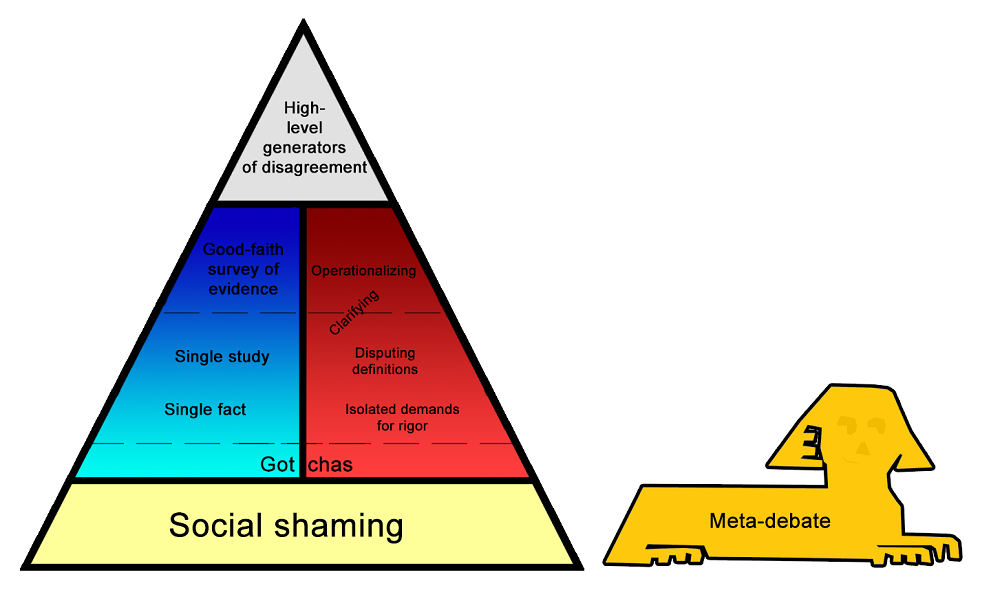
Scott claims—and I agree—that the vast majority of “debate” online compose mostly of meta-debate (discussing the events of the debate and the motives of the debaters rather than discussing the issue itself) and social shaming (making a case why somebody is so incredibly cringe for believing what they do that they’re not even worth engaging with beyond mockery and aggression). These behaviors aren’t even meant to convince anybody of anything, just to play to the crowd of people who already agree with you.
Ethics are sneaking into the conversation already. To criticize somebody’s character you need to make a normative case that they have crossed some line, and the drawing of those lines is what we call ethics. But it’s largely a waste of time to analyze this phase too deeply, because unlike the meta-debaters we’re not interested in morality as a tool to opine upon the worthiness of debaters. We’re investigating in how ethics should influence the arguments that we make and how we digest the arguments that others make. To that end, let’s move on to actual meaty political disagreements.
As you are probably well aware, American politics is dominated by two parties. What you may not have realized is that though these parties each capture very close to half of the vote in any given national election, only about two thirds of Americans identify as Democrats or Republicans (one third each), while the remaining third identify as independent, lacking partisan identity even while they essentially vote like partisans. This is due to what is called “negative partisanship”, where voters shape their behaviors and rationale around opposing the political party they dislike, rather than boosting and enabling the one they do. Hater behavior.
So the web is awash in a lot of rationale for “why nots”, far outnumbering the “whys”. People can articulate their opposition to the war with Iran (my take: we really should call it the Third Gulf War) but do not so eagerly offer an alternative grand geopolitical strategy. The strongest partisans more readily spread attacks on their enemies than offer justification and explanation for their own programme. I wrote a whole essay thinking through why this pattern repeats even outside of politics. It’s easier and more fun to be on the attack than on the defense.
This rationale is inverted from what we’d ideally see. Rather than the discourse consisting of individuals reasoning through which policy or party best advances their terminal values, it is almost entirely post-hoc reasoning arriving after they’ve already chosen their political stance for social and aesthetic reasons. This means there’s generally no stable ethical framework informing how critics attack policy or individuals, they will swing between the three (as well as more exotic moralities) to whichever appeal is most convenient to score points at that moment:
- Politician Alice is economically illiterate, look at these charts showing unemployment on the rise! (Consequentialism)
- Abortion is murder and murder is bad! (Deontology)
- Politician Bob has skeletons in his closet, read this tell-all article from one of his victims! (Virtue Ethics)
- Politician Charlie’s kids hate him because he’s a bad dad! (Confucianism?)
- Politician David is weak and pathetic and cannot overcome his stronger opponents (Darwinism?)
You’re perfectly welcome to employ this scattershot technique (you probably already do) but you’re only going to contribute to the everlasting cacophony. People don’t change their mind after hearing n number of gotchas. People change their mind when they decide you completely understand why they believe what they do—you pass an Ideological Turing Test—and you then successfully make a principled positive case that appeals to their terminal ethical values. The good news: most of us have overlapping terminal values, and the real battle is waged over the facts and how they are delivered, which is something a lot more tractable than rebuilding somebody’s ethics from the ground up. The bad news: once a bad faith interlocutor has clocked you as a bad guy, you might never be able to convince them that you actually do share terminal values.
But we’re getting distracted, the purpose of this exercise is not to learn how to persuade people. We want to decide what we believe in a consistent manner, and it seems like the broader discourse’s failure to pick a lane means we need to do just that: pick one and discard arguments that don’t match our ethics of choice, right? I don’t think that’s necessary. We can still draw on all of the ethical frameworks, but we need to be consistent with where we apply them.
IV: The Three Modes
1. Meta-Consequentialism
Consequentialism is entirely unsuited for mass consumption.
Unrepentant criminals, having obviously violated their deon, will fall back to justifying their actions along consequentialist lines. The worst of the political and cultural moments of the modern era: racism, eugenics, fascism, each rested on basic consequentialist defenses that can be frighteningly compelling in isolation. They aren’t valid consequentialist arguments, mind you, they’re deeply fallacious and often just factually incorrect. And that’s precisely the issue at hand with consequentialism. It’s simply too easy to get wrong. A precisely correct understanding of cause-and-effect requires unattainably high levels of information in our deceptively complex world. Of course it’s possible to do good consequentialist thinking even with limited information, but that requires you to understand your limits, which requires you to be highly aware of cognitive biases, which is not something our masses have ever come even close to achieving.
Some people use this line of thinking to advocate forsaking democracy, for the demos have proven they cannot be trusted to wield power responsibly and consistently. Fukuyama would counter that the winning attribute of democracy is its unassailable legitimacy. The people are such a more self-evidently legitimate base of power than any other form of government that it provokes both an autochthonous and international reaction (often violent and impassioned) against any backsliding in a way that military coup #7 in a dictatorship does not. In other words, it trades away efficiency and effectiveness in the present for stability and legitimacy in the long term.
But representative democracies outnumber direct democracies for a reason, and it’s not just logistics. Filtering power for the right tail of the bell curve gives you an elite that can employ consequentialism more effectively than the populace. So while I think there is a consequentialist argument against consequentialism in the general case—the average joe is overcome by cognitive biases and will make bad, irrational, self-serving decisions—there is an institutional backstop in an elite-governed democracy that makes consequentialism a useful lens for policy. Experimental science is essentially an elite project to rigorously establish cause and effect (buffered by self-correction mechanisms like replication) that can be used to carefully inform policy.
In my college American history class my professor called this sort of ingenious institutional engineering lowercase-r republicanism, championed by the likes of Hamilton and Madison. They argue at length in the Federalist Papers that they can design a government such that it would avoid the failure modes of the countless states before (including the nominally democratic England) that remained under tyranny due to the immutable Augustinian lusts of avarice and ambition. They also argue they can reign in the radicalism that had so recently scorched the continent and the motherland in the various wars of religion. The Americans were not in any sense more virtuous than their European forebears (maybe even less!), but they managed to build a system that turned these destructive impulses toward productive ends, toward industry and civic participation and multiculturalism and a record-breaking ZERO sectarian wars.
They also kept chattel slavery around for another century, so republicanism was clearly not enough on its own to solve injustice. There is another ingredient to the American brew.
2. Rules For Fools
While the US Constitution and the Federalist Papers are deeply republican documents replete with checks and balances and governance mechanisms, my professor taught that the Bill of Rights and the Declaration of Independence are lowercase-l liberal documents. They are full of broad claims about intrinsic and inviolable rights of mankind, penned by the greatest liberal after Locke and before Rawls: Thomas Jefferson (unfortunately his liberality was not enough to overcome the social and economic pressure to own slaves in Virginia so he is also a bit of a hypocrite).
Liberalism is a set of rules that you don’t break. You can reason all you want about the benefits of such and such policy, but should it violate the rights of your citizens it is a non-starter. Liberalism is thus a straightforward example of a deontology, one concerned with preserving individual rights regardless of the consequences. John Locke reasons for these natural rights from base principles—what he calls the “state of nature”—in a manner more than a little reminiscent of Kant. I will not exhaustively list the rights that Jefferson and Locke have so lovingly enumerated, but they’re stuff like the right to life, liberty, property, freedom of speech, assembly, the press, freedom of association, etc.
So if you can grant consequentialist arguments for and against policies2 and their outcomes, you can also grant deontological arguments for policies that enshrine new limits and protections and against policies that infringe upon our rights. You can also sort of stitch them together, making consequentialist arguments with a deontological terminus, like “the A Ruling is going to set a bad legal precedent that will open up new attacks on the Right to B”.
In summary: Consequentialism (Science) is how we advocate for policy, Deontology (Rights) is how we constrain policy. If our world were simple and static we could use these two guiding stars to immutably program our governance as a big software application, but unfortunately we must lean upon the arm of flesh. How do we choose who we lean upon?
3. The Good Guys Are In Charge
Subjectively, it feels like scandals used to be serious business and now they’re just whatevs.
When you read about Teapot Dome or Watergate or even something as recent as John Edwards, you get the sense that it used to be possible to really permanently end someone’s career and wipe away their good name by exposing that they had engaged in some skullduggery. But the cracks begin to show in the postmodern era: JFK and Bill Clinton engaged in icky affairs with subordinates while in office and escaped with their reputations more or less intact (at least among their political allies). Every president since Vietnam has repeatedly lied to the American public and violated international and domestic law, some more egregiously than others e.g. Iran-Contra and the revelations of the Snowden Leaks.
And there’s Donald Trump, a man essentially impervious to controversy, a man who managed to get elected twice after funneling campaign funds as hush money to a mistress, bantering about sexual assault on a hot mic, and refusing to accept election results for several months.

Would the Jan 6 mob have lynched Mike Pence if they got their hands on him? My personal odds on this occurring are somewhere between 0% and 100%
I like to think most Trump voters agree that those scandals are bad, but they have consequentialist policy reasons to prefer him to the alternative and continue to support him. I do not think this is a good strategy. Surely there are enough citizens in the United States that we can find someone to lead us with no skeletons in their closet, no sex scandals or bribery or fraud or whatever. And I think the voters actually have a pretty good innate sense for virtue and vice, given that they’re specifically paying attention to it and not whatever pie-in-the-sky outcomes the politician is promising.
So that is my most controversial directive: while consequentialism and deontology should inform and constrain our decisions about policy, virtue ethics ought to inform and constrain our decisions about people. Our republic is certainly not invincible, and virtuous leaders pose less of a threat to it than those accustomed to getting what they want by hook or crook.
Conversely, I think there are a lot of dumb controversies that we are trying to upgrade to scandals and it is eroding their utility as a signal. Every valid Donald Trump controversy (Crypto grifting for personal enrichment) is drowned by an avalanche of overblown Donald Trump controversies (Russiagate, East Wing Ballroom, Classified Document Mishandling). Contrary to what your gut may tell you, it is not a good strategy to lunge at every opportunity to get your kicks in. It’s just screaming yourself hoarse, which depletes oppositional energy and distorts framing for the truly egregious scandals that just get added to the pile. It also teaches the same people that you should be persuading to come over to your side that you are just shrill and hysterical and blinded by hatred.
I also feel this way about drama (or “commentary” as they prefer to be called) YouTubers, but the world isn’t ready for that essay yet.
As a voter, you only really have two levers: your vote in the election (plus donating/canvassing if you’d like to pull harder), and yelling at your representatives (plus convincing other people to yell the same things if you’d like to pull harder) in the space between elections. If you want to vote for the right people, I recommend heavily penalizing your consequentialist reasoning because you’re probably doing it wrong anyway and trying to find the candidates that will do consequentialism the right way (technocracy), honor the rights that our nation stands for (liberalism), and remain honest and upstanding in their conduct (no mistresses, no minors, no bribes).
Now you can go back to being a good faith listener. And when somebody tries to rhetorically impose an abhorrent conclusion upon you, remember your foundation:
Consequentialism for policy, Deontology for rights, and Virtue Ethics for leaders.
1.
Some argue that religion often reduces to a sort of consequentialism anyway since the rules are tied to promises about what shall happen in the hereafter. But not all religions necessarily believe in an afterlife or an interventionist god. In my experience those religions that do believe in an afterlife are usually more interested in God’s will and nature rather than enumerating the specific rewards and punishments. ↩
2.
I have been careful to use the word “policy” instead of “laws” in this section because we have three branches in the U.S. Government and only one of them (the legislature) authors “laws”, while the term “policy” could be thought of as describing the laws the legislature enacts in addition to the enforcement from the executive and the rulings of the judiciary, all of which are subject to our consideration and criticism. ↩